Sometimes — but not always. In most standard residential carpet installations across the UK, professional carpet fitters do not use glue. Instead, carpet is secured using gripper rods — thin strips of spiked wood fixed around the room perimeter — combined with underlay and careful stretching. Adhesive is reserved for specific installation types where gripper rods are not suitable, including carpet tiles, direct-stick broadloom installations, and certain commercial projects.
Understanding when glue is used, when it is not, and why the method matters is important for any homeowner planning new carpet in London. The installation method affects the finished result, the long-term performance of the carpet, the ease of future replacement, and in some cases the safety and health considerations for your household.
This guide covers everything you need to know about how professional carpet fitters secure carpet in UK homes and businesses and when adhesive genuinely is the right choice.
How Is Carpet Normally Fitted in UK Homes?
The overwhelming majority of residential carpet installations in the UK use the stretch-in method — also called the gripper rod method. This is the standard approach for fitted carpet in bedrooms, living rooms, hallways, stairs, and landings across homes in London and the rest of the UK.
How gripper rods work?
Gripper rods are thin strips of wood or metal approximately 25mm wide, fitted with rows of small angled pins pointing upward and toward the wall. They are fixed around the entire perimeter of the room, positioned approximately 6 to 8mm from the skirting board — roughly the thickness of the carpet being fitted.
Underlay is then laid across the floor within the gripper rod perimeter and stapled or taped in place. The carpet is rolled out over the underlay, hooked onto the gripper pins at one wall, then stretched across the room using a knee kicker and power stretcher before being hooked onto the grippers at the opposite wall. The edges are trimmed neatly and tucked between the gripper rod and the skirting board using a bolster chisel, leaving a clean, seamless finish at every wall.
No adhesive is used at any point in this process. The carpet is held entirely by the tension created through stretching and the grip of the pins around the perimeter. This is why correct stretching is so critical to a successful installation — insufficient stretching allows the carpet to relax and ripple after fitting, which is one of the most common carpet installation mistakes seen in UK homes.
Why the gripper rod method is preferred for residential carpet?
The stretch-in method has several significant advantages over adhesive installation for residential settings. The carpet can be lifted and replaced without damaging the subfloor, making future re-carpeting straightforward and cost-effective. The underlay remains replaceable independently of the carpet. The installation produces no adhesive fumes or VOC emissions beyond those from the carpet itself. And critically, the finished result — a taut, smooth carpet surface anchored firmly at every wall — is exactly what a well-fitted residential carpet should look and feel like.
When Do Carpet Fitters Use Glue?
There are specific situations where adhesive is the correct and professional choice for carpet installation. These fall into four main categories.
Carpet tiles
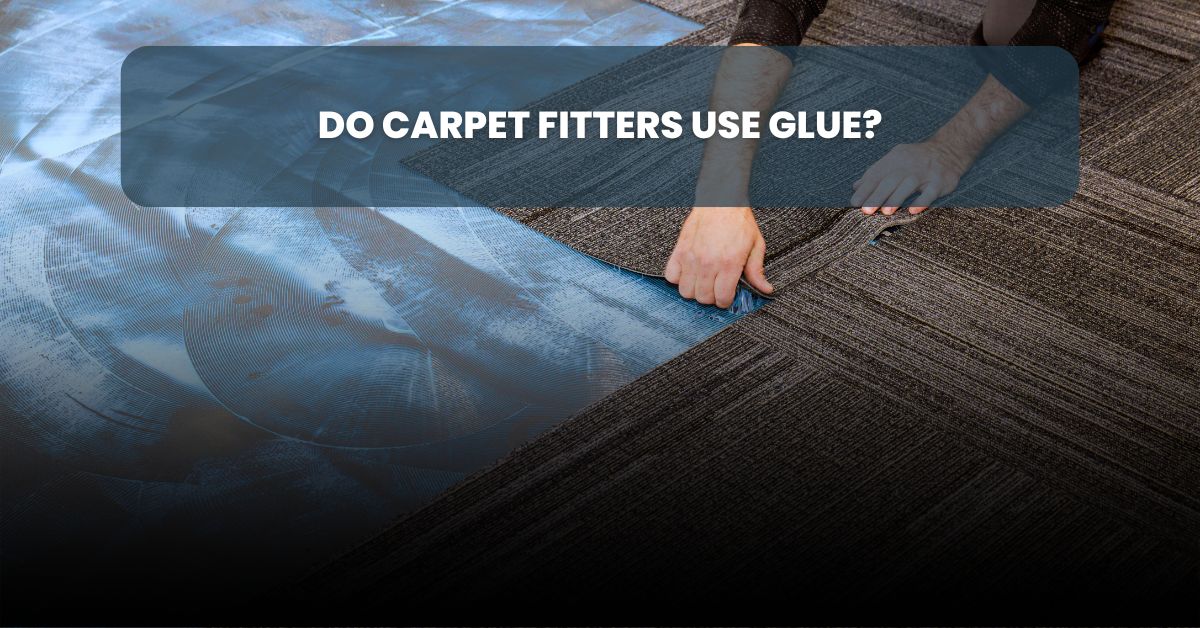
Carpet tiles are the most common situation in which adhesive is used for carpet installation in the UK. Tiles — typically 50cm × 50cm square modules — are laid directly onto the subfloor using pressure-sensitive adhesive rather than gripper rods and underlay. The adhesive bonds the tile firmly to the floor, preventing movement, curling at the edges, and the trip hazards that loose tiles would create under sustained foot traffic.
Pressure-sensitive adhesive is specifically designed for this purpose. It bonds firmly enough to hold tiles securely in place but allows individual tiles to be lifted and replaced when damaged or heavily soiled — one of the primary advantages of carpet tiles in commercial and rental property settings. If you are comparing carpet tile installation against traditional fitted carpet for a London property, understanding the difference between residential and commercial carpet helps clarify which approach is right for your specific setting.
Direct-stick broadloom installation
In some commercial settings — large open-plan offices, hotel corridors, retail floors, and healthcare facilities — broadloom carpet (full-width roll carpet) is glued directly to the subfloor rather than fitted using the stretch-in method. This is called direct-stick or full-bond installation.
Direct-stick installation uses a specialist carpet adhesive spread across the entire subfloor surface before the carpet is laid. The result is an extremely stable installation with no movement whatsoever — critical in high-traffic commercial environments where any carpet movement would quickly create visible wear lines and potential trip hazards. The trade-off is that direct-stick carpet is significantly more difficult and expensive to remove when replacement is needed.
Stair nosings and awkward areas
On staircases, gripper rods are fitted on both the tread and the riser of each step. In some situations — particularly on curved or winding staircases, or where the stair profile makes gripper rod placement difficult — a small amount of contact adhesive is used to secure the carpet at the nosing of each step in addition to the gripper. This is a supplementary fixing rather than a full adhesive installation and is used at the fitter’s discretion where additional security is needed.
Felt-backed and foam-backed carpet
Some budget carpet types — particularly those with a felt or foam backing rather than a hessian or action-back backing — cannot be effectively fitted using the gripper rod method. The backing material is too soft to grip securely onto the pins. These carpets are either glued directly to the subfloor or fitted using a combination of adhesive perimeter fixing and double-sided tape. Felt-backed and foam-backed carpets are common in some budget ranges and are frequently used in rental properties where low installation cost is the priority.
What Type of Glue Do Carpet Fitters Use?
The type of adhesive used depends entirely on the installation method and the carpet type.
Pressure-sensitive adhesive is the standard choice for carpet tiles. It is a water-based adhesive applied to the subfloor using a trowel or roller. It becomes tacky rather than forming a permanent hard bond, which is what allows tiles to be lifted and repositioned without damaging the floor.
Full-bond carpet adhesive is used for direct-stick broadloom installations. This is a stronger, more permanent adhesive that forms a complete bond between the carpet backing and the subfloor. It is applied across the entire floor area using a notched trowel and requires the carpet to be laid into the wet adhesive before it cures. Removal later requires significant effort and often causes damage to the subfloor surface.
Contact adhesive is occasionally used for seaming — joining two pieces of carpet together — in conjunction with heat-activated seam tape. The seaming iron melts the adhesive in the tape, bonding the two carpet edges firmly together. This is not adhesive applied to the floor but specifically to the join between carpet sections.
Double-sided carpet tape is used for felt-backed and foam-backed carpets, securing the perimeter to the subfloor without the full commitment of a liquid adhesive. It is also used to secure underlay joins and, in some situations, to fix carpet in areas where gripper rods cannot be used — such as in doorways and around obstacles.
Does Adhesive Affect VOCs and Indoor Air Quality?
This is a relevant concern for homeowners, particularly those with young children, pets, or household members with respiratory sensitivities. Carpet adhesives — particularly full-bond commercial adhesives — release VOCs during and after application. The off-gassing period from adhesive is typically more intense and longer-lasting than the off-gassing from the carpet itself.
In a standard residential stretch-in installation where no adhesive is used, the only VOC source is the carpet backing and manufacturing compounds. These dissipate quickly with good ventilation — typically within 24 to 72 hours. In an adhesive installation, particularly a full direct-stick commercial job, the ventilation requirement is more significant and the period before the space is safe to occupy may extend to 48 to 72 hours or longer depending on the adhesive used and the ventilation available.
If adhesive has been used in your installation, keep windows fully open for at least 48 hours after fitting and use fans to actively move air through the space. This is consistent with the guidance in our full post on whether it is safe to sleep in a room after carpet installation, which covers VOC exposure, ventilation, and who needs to take extra care in the hours after fitting.
Can You Remove Glued Carpet?
Removing carpet that has been glued to the subfloor is significantly more labour-intensive than removing stretch-in carpet. Stretch-in carpet can be lifted quickly — the carpet is pulled off the gripper pins, rolled up, and removed with minimal subfloor disturbance. The gripper rods are then removed or left in place for the new installation.
Glued carpet requires the adhesive bond to be broken across the entire floor area. For pressure-sensitive adhesive used with tiles, this is relatively straightforward — tiles can be lifted individually and residual adhesive removed with a floor scraper and appropriate solvent. For full-bond direct-stick installations, removal is a significant undertaking. The adhesive often pulls the surface layer of a concrete subfloor away during removal, requiring floor levelling and preparation before new flooring can be laid.
This is one of the practical reasons why stretch-in installation with gripper rods is strongly preferred for residential settings. When it comes to re-carpeting a London home, the ease and low cost of removing stretch-in carpet and fitting new carpet over the same gripper rods — or new ones — represents a meaningful long-term advantage over adhesive alternatives. Our guide on whether you can lay new carpet over old underlay is relevant here too — understanding what can and cannot be reused during re-carpeting saves both time and cost.
What Should You Ask Your Carpet Fitter Before Installation?
Before any carpet installation begins, asking your fitter a small number of straightforward questions ensures you understand exactly what method is being used and what to expect.
Ask whether the installation will use gripper rods or adhesive and why. Ask whether the carpet type you have chosen is suitable for the stretch-in method or requires a different approach. If adhesive is being used, ask what type, how long the curing time is, and when the room will be safe to occupy. Ask whether old carpet and underlay removal is included in the quote, and whether subfloor preparation is needed before fitting begins.
Any professional carpet fitter should answer all of these questions clearly and without hesitation. If a fitter is vague about their installation method or cannot explain why they are choosing adhesive over gripper rods for a standard residential room, that warrants further questions before work begins. Our carpet supply and fitting service in London provides full transparency on installation method, materials, and aftercare from the first consultation.
Frequently Asked Questions
Do carpet fitters use glue in UK homes?
Not usually. Most residential carpet installations in the UK use the stretch-in method with gripper rods and underlay — no adhesive is involved. Glue is used for carpet tiles, direct-stick commercial installations, felt-backed carpet, and in specific situations on stairs or awkward areas where additional fixing is needed.
Is glued carpet better than gripper rod carpet?
Not for residential settings. Gripper rod installation is preferred in homes because it produces a high-quality result, allows easy future replacement, does not involve adhesive fumes, and can be re-stretched if the carpet relaxes. Direct-stick adhesive installation is appropriate for specific commercial applications but offers no meaningful advantage in a domestic setting.
How long does carpet adhesive take to dry?
Pressure-sensitive adhesive used for carpet tiles is typically ready to walk on within 30 to 60 minutes of laying. Full-bond direct-stick adhesive requires a longer cure time — usually 12 to 24 hours before heavy foot traffic, and 48 hours before the space is fully back in normal use. Always follow the adhesive manufacturer’s guidance and your fitter’s advice on curing time.
Can carpet be re-stretched if it was fitted with gripper rods?
Yes. One of the significant advantages of gripper rod installation is that carpet can be re-stretched if it develops ripples or bubbles after fitting. A professional fitter can lift the carpet from the grippers, re-stretch it using a power stretcher, and re-hook it without removing or replacing the carpet itself. This is not possible with glued carpet.
Does carpet glue damage the floor?
Pressure-sensitive adhesive used for carpet tiles generally does not damage hard subfloors and can be removed cleanly. Full-bond direct-stick adhesive can damage concrete and timber subfloors during removal — particularly if the bond has fully cured over many years. This is a meaningful consideration when choosing an installation method for a room where the subfloor condition and future flexibility matter.
Conclusion
In most UK homes, carpet fitters do not use glue. The stretch-in method using gripper rods, underlay, and careful professional stretching is the standard residential installation approach — delivering a secure, high-quality result without any adhesive involved. Glue is used when the carpet type or setting specifically requires it — carpet tiles, direct-stick commercial installations, felt-backed carpet, and certain stair situations.
Knowing which method your fitter is using, why, and what it means for your installation puts you in the best position to ask the right questions, understand the aftercare requirements, and protect your investment from day one.
At London Carpets and Flooring Hub we fit carpet across London using the correct method for every carpet type and setting — with full transparency on installation approach, materials, and aftercare from the first free consultation.