
Yes, you can sleep in a room after carpet installation in most cases but waiting 24 hours is strongly recommended. Newly fitted carpet releases small amounts of volatile organic compounds (VOCs) from the backing, adhesives, and fibres during the first few hours after installation. These compounds are not acutely dangerous for healthy adults, but they can cause mild irritation in poorly ventilated rooms, particularly for young children, elderly people, and anyone with asthma or respiratory sensitivities.
Getting new carpet fitted is exciting. The room looks transformed, the pile feels fresh underfoot, and everything smells new. But that new carpet smell raises an immediate and very reasonable question for most London homeowners: is it safe to sleep in the room tonight, or should I wait?
The answer depends on the type of carpet fitted, how well the room is ventilated, who will be sleeping in the room, and whether adhesives were used during installation. This guide covers everything you need to know — what causes the new carpet smell, how long it lasts, who needs to be most cautious, and exactly what to do in the hours after fitting to make the room safe and comfortable as quickly as possible.
What Causes the New Carpet Smell After Installation?
The distinctive smell of new carpet comes primarily from volatile organic compounds — commonly referred to as VOCs. These are chemical compounds that evaporate at room temperature and are present in the carpet backing, the adhesives used during manufacture, and in some cases the fitting adhesives used during installation.
The most commonly cited VOC in new carpet is 4-phenylcyclohexene, or 4-PCH — a by-product of the latex backing manufacturing process. It is responsible for the characteristic new carpet smell most people recognise. Other VOCs including formaldehyde, benzene, and toluene can also be present at very low levels in some carpet products, particularly lower-grade synthetic options.
It is important to keep this in perspective. The VOC levels released by new carpet are significantly lower than those released by fresh paint, new furniture, or newly laid hard flooring adhesives. In the UK, carpet products sold through reputable retailers must meet safety and emissions standards. The concern is not acute toxicity — it is mild irritation from prolonged exposure in a poorly ventilated space, which is exactly the situation a sleeping person in a closed bedroom represents.
The smell typically peaks in the first 24 to 72 hours after installation and dissipates quickly with good ventilation. In most cases it is largely undetectable within three to five days.
Is It Safe to Sleep in a Newly Carpeted Room?
For healthy adults, sleeping in a newly carpeted room after 24 hours of ventilation is generally considered safe. The VOC levels in a well-ventilated room after the first day are low enough that they are unlikely to cause any meaningful discomfort or health effect.
However, certain groups need to take extra care.
Children and babies
Children and babies are more vulnerable to VOC exposure than healthy adults for two reasons. First, they breathe more air relative to their body weight. Second, babies and toddlers spend a significant amount of time on the floor itself — directly in contact with and close to the carpet surface where VOC concentrations are highest. For children and babies, waiting 48 to 72 hours before sleeping in a newly carpeted room is the recommended approach, combined with thorough ventilation throughout that period.
People with asthma or respiratory conditions
New carpet VOCs can trigger or worsen symptoms in people with asthma, allergies, or other respiratory sensitivities. If anyone in the household has a diagnosed respiratory condition, extending the waiting period to 48 to 72 hours and ensuring the room is fully ventilated before they sleep in it is strongly advisable. If symptoms such as headaches, eye irritation, or breathing difficulty occur, leave the room and increase ventilation immediately.
Elderly people
Elderly people, particularly those with existing health conditions, should apply the same caution as people with respiratory sensitivities. Waiting 48 hours with good ventilation before sleeping in the room is the sensible approach.
Healthy adults
For healthy adults without respiratory conditions, sleeping in a newly carpeted room after one night with the window open is unlikely to cause any significant issue. That said, waiting the full 24 hours with active ventilation remains the best practice even for those without specific health concerns.
How Long Does New Carpet Off-Gassing Last?
Off-gassing — the process by which VOCs evaporate from a new carpet — is most intense in the first 24 to 72 hours after installation. The rate of off-gassing drops sharply after the first day and continues to decline steadily over the following week.
By day three to five, the smell will be noticeably reduced in a well-ventilated room. By the end of the first week, most people find the smell has largely disappeared. In rooms with poor ventilation or very low air circulation, this process takes longer — which is exactly why ventilation in the first 24 to 72 hours is the single most effective action you can take to speed up the process and make the room comfortable sooner.
The type of carpet affects how long off-gassing lasts. Synthetic carpets — particularly budget polypropylene — tend to off-gas more noticeably than wool or high-grade nylon options. Premium natural fibre carpets generally have a shorter, less intense off-gassing period. This is one of several practical reasons why wool carpet performs differently from synthetic options in real-world domestic settings.
What to Do Immediately After Carpet Installation
The actions you take in the first few hours after fitting make the biggest difference to how quickly the room becomes comfortable and safe for sleeping.
Ventilate immediately and continuously
Open all windows and doors in the room as soon as the fitters have finished and keep them open for as long as possible — ideally for the entire first 24 hours. If the weather makes this impractical, open windows as wide as possible during the day and leave them slightly ajar overnight. Cross ventilation — having windows open on opposite sides of the room or house — moves air through the space far more effectively than a single open window.
Use a fan to increase air circulation
A standing fan or ceiling fan pointed toward an open window actively draws VOCs out of the room and replaces them with fresh air. This is significantly more effective than passive ventilation alone and can meaningfully reduce the time it takes for the room to feel fresh and odour-free.
Keep the room temperature moderate
VOCs evaporate faster at higher temperatures. A warm room with poor ventilation is the worst possible combination for off-gassing — it accelerates the release of VOCs while trapping them inside. Keeping the room at a moderate temperature while ventilating well strikes the right balance — enough warmth to allow the off-gassing to complete, enough air movement to carry it away.
Do not seal the room
Closing the door to a newly carpeted room to keep the smell contained does exactly the opposite of what you want. It concentrates the VOCs in the room and slows the off-gassing process significantly. Keep the room open and ventilated at all times during the first 24 to 72 hours.
Vacuum after 48 hours
Vacuuming the carpet after 48 hours removes loose fibres and any surface particles from the installation and helps settle the pile. Use a low suction setting for the first few weeks and avoid the beater bar for the first month. Regular vacuuming from the start is one of the best things you can do for a new carpet and understanding how to vacuum a newly installed carpet correctly will protect your investment from day one.
Does the Type of Adhesive Used Affect Safety?
In most residential carpet installations in the UK, adhesive is not used at all. Standard fitted carpet is secured using gripper rods around the room perimeter — no adhesive is applied to the floor or the carpet itself. In this case the only VOC source is the carpet and its backing, and off-gassing is relatively mild.
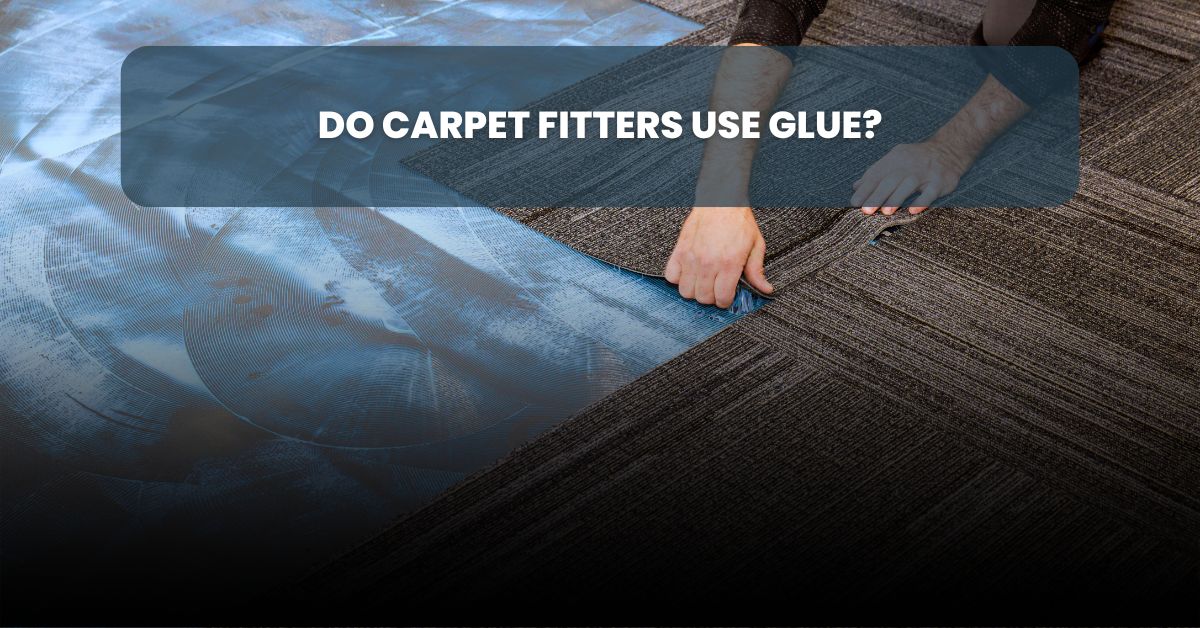
Adhesive is used in two specific situations: carpet tiles, which are glued directly to the subfloor, and direct-stick broadloom installations in commercial settings. If adhesive has been used in your installation, the off-gassing period is more significant and the waiting period before sleeping in the room should be extended to at least 48 hours with continuous ventilation. The adhesive itself will produce a stronger and longer-lasting odour than the carpet alone.
If you are unsure whether adhesive was used in your installation, ask your fitter before they leave. This is a straightforward question that any professional fitter should answer clearly. Our carpet supply and fitting team in London always advises homeowners on aftercare including ventilation requirements based on the specific installation method used.
How to Choose Lower-VOC Carpet for Future Installations
If VOC sensitivity is a concern for your household — particularly if you have young children, babies, or family members with respiratory conditions — choosing a lower-emission carpet from the outset reduces the problem significantly.
Look for carpets that carry recognised low-VOC certifications. In the UK and Europe, the key certifications to look for are the EU Ecolabel and the OEKO-TEX Standard 100, both of which require products to meet specific limits on harmful substance emissions. Wool carpet and natural fibre options are generally lower in synthetic VOCs than polypropylene or nylon alternatives.
Asking your carpet supplier specifically about VOC emissions and certifications before purchasing is entirely reasonable and any reputable supplier should be able to provide this information. Planning installation timing also helps — fitting carpet when you can leave windows open for several days, during warmer months when ventilation is easier, gives off-gassing the best conditions to complete quickly before the room is occupied again.
The average lifespan of a well-chosen and properly maintained carpet is 10 to 15 years in a residential setting, which means the off-gassing period of the first few days is a very small fraction of the total time you will spend living with and benefiting from the floor.
Frequently Asked Questions
Can I sleep in the room the same night carpet is fitted?
For healthy adults in a well-ventilated room, sleeping in a newly carpeted room the same night is unlikely to cause serious harm. However, waiting 24 hours is strongly recommended. For children, babies, elderly people, or anyone with asthma or respiratory sensitivities, waiting 48 to 72 hours with continuous ventilation is the right approach.
How long does new carpet smell last?
New carpet smell is most noticeable in the first 24 to 72 hours after installation. With good ventilation it reduces significantly after the first day and is largely undetectable within three to five days in most cases.
Is new carpet smell harmful?
New carpet smell comes from VOCs released during off-gassing. For healthy adults in a ventilated room, the levels are not acutely harmful. However, prolonged exposure in a closed, unventilated space can cause mild irritation — headaches, eye irritation, or throat discomfort. Children, babies, and people with respiratory conditions are more sensitive and should avoid sleeping in a newly carpeted room for at least 48 to 72 hours.
Does opening a window get rid of new carpet smell faster?
Yes significantly. Ventilation is the single most effective way to accelerate off-gassing and reduce new carpet smell. Open windows on opposite sides of the room for cross ventilation and use a fan to increase air movement. The more fresh air moving through the room, the faster the smell dissipates.
Do wool carpets smell less than synthetic carpets?
Wool carpets generally have a shorter and less intense off-gassing period than synthetic alternatives because they contain fewer manufactured chemical compounds. Some wool carpets have a mild natural lanolin smell immediately after fitting which also disappears quickly with ventilation.
Can pets sleep in a newly carpeted room?
Apply the same caution as for children. Pets spend a significant amount of time on the floor and are therefore more exposed to VOCs at surface level. Keep pets out of a newly carpeted room for at least 24 to 48 hours and ensure thorough ventilation before allowing them back in.
Conclusion
In most cases you can sleep in a room after carpet installation but waiting 24 hours with the windows open is the right approach for healthy adults, and 48 to 72 hours for children, babies, pets, elderly people, and anyone with respiratory sensitivities. Ventilation is the single most effective action you can take, and it costs nothing.
The off-gassing period is short, the smell disappears quickly, and a well-chosen carpet fitted by a professional team will give you years of comfort and warmth in return for a few days of open windows.
At London Carpets and Flooring Hub, we supply and fit carpets across London, and our team advises on every aspect of aftercare — from ventilation after fitting to vacuuming, maintenance, and long-term care — so your new carpet performs exactly as it should from day one.